

-Passive and active photonic components
- Full PIC design, layout, validation and tapeout
- Photonic PDK development
- Passive and active photonic components
- Full PIC design, layout, validation and tapeout
- Photonic PDK development
- Passive and active photonic components
- Full PIC design, layout, validation and tapeout
- Photonic PDK development
- Photonic package feasibility study and prototyping
- Fiber to chip coupling simulation and analysis
- RF package substrate, interposer, design
- Advise on PIC System Development
- Performing Feasibility Studies
- Identify PIC Fabrication and Packaging Partners
Rymoslite specializes in custom PIC chip development, offering expertise in passive and active photonic component design, full PIC design and tape-out, PDK development and multi-product wafer (MPW) submission to photonic foundries.
Our services also include photonic package development, including RF substrate or interposer design and fiber-to-chip coupling. We can do feasibility studies for your photonic project starting from concept development to prototyping by identifying photonic foundry and packaging partners.
Our Services
End-to-end photonic solutions tailored to your specifications
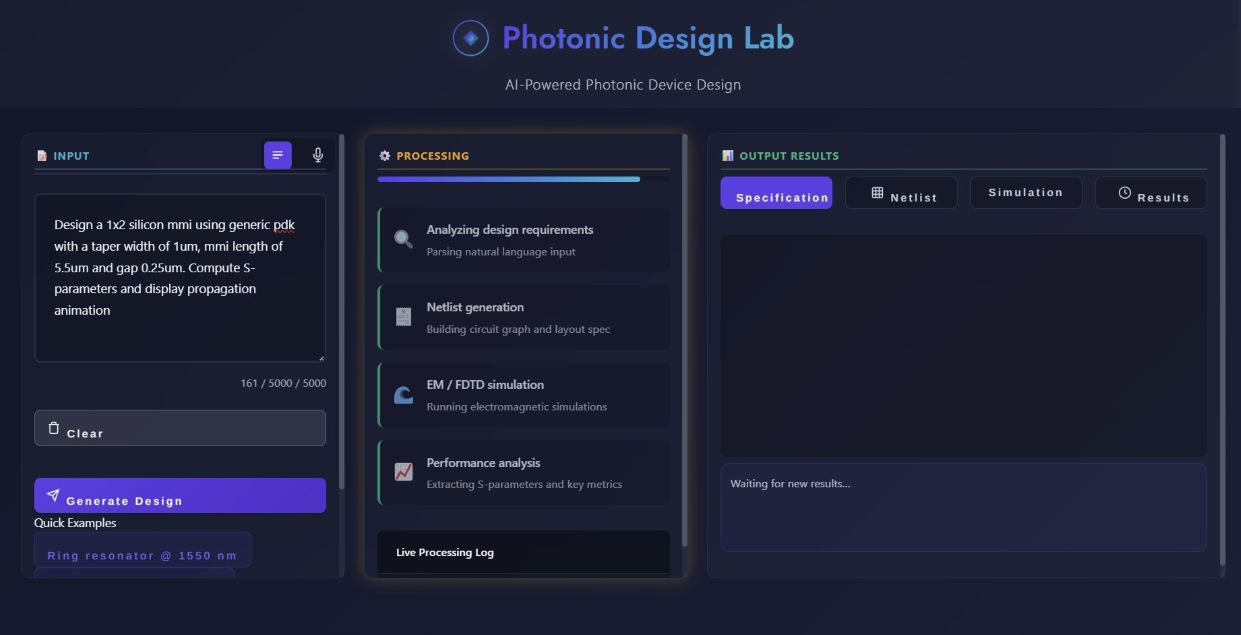
Photonic System Design Meets AI
The Photonic industry is now pushing toward co-packaged optics with targets such as <$0.25/Gbps cost, ~1 pJ/bit energy efficiency, and >0.5 Tbps/mm² density, which effectively demands >10× improvements in energy efficiency and up to ~90% cost reduction compared to current pluggable systems. Yet the present PIC development flow remains highly fragmented—spanning EM/device/circuit simulation, layout, DRC, tapeout, fabrication (often ≥3-month cycles), testing, and packaging—with each step requiring heavy human-driven iteration. As complexity grows, the bottleneck is less about ideas and more about converting them into qualification-ready hardware at fab-compatible speed and repeatability.
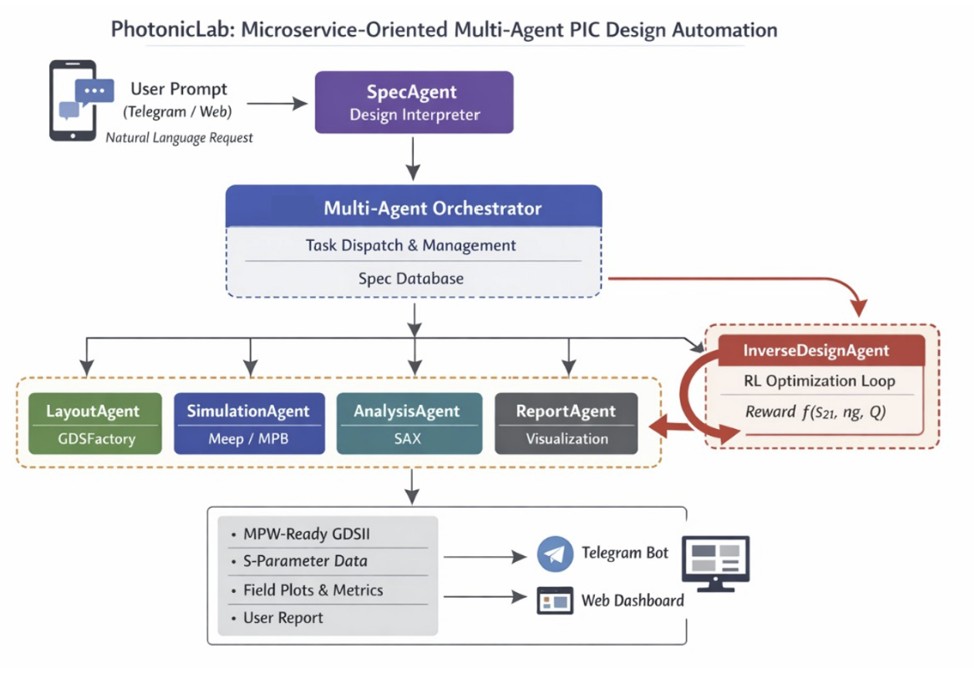
This is precisely where agentic execution platforms could unlock structural leverage. Integrating currently disjointed photonic design tools into a unified, automated workflow—where natural-language prompts initiate design, optimization, and verification of photonic building blocks through full-chip tapeout—can dramatically compress iteration cycles. Taking it a step further, virtual fab AI agents that co-optimize PDKs, process corners, and yield sensitivities prior to physical fabrication would allow teams to effectively “pre-tapeout” GDSII designs into a simulated manufacturing stack—surfacing variability risks, process incompatibilities, and packaging constraints before committing to the multi-month fab loop. Bridging this design-to-device-to-packaging continuum with agentic systems could be a key enabler for moving from R&D-grade photonics to true HVM-ready co-packaged optical systems at the scale next-gen compute and networking platforms demand.
Photonic Design Tools Expertise
Deep knowledge across the photonic integration stack
-
Photonic
-Ansys Lumerical, Tidy3d, Comsol, etc.
- Python based open-source Tools: GDSFactory, SAX, Meep/MPB, etc.
-
RF Design
- Ansys HFSS, Circuit, COMSOL multi-physics,etc.
- open source and custom developed tools.
-
Design Automation
- Custom scripting and automated design flows to accelerate development cycles and ensure design consistency.
-
3D Cad Tools
-Mechanical, Opto-mechanical: Solidworks, Zemax Optical Stud.